Current Issue- Full Articles

  • APCO Broadband Summit Focuses on FirstNet and Next-Gen Apps

    Earlier this week, I attended the Association of Public-Safety Communications Officials (APCO) Broadband Summit & Expo, an annual gathering of internal public safety communicators and industry personnel in Washington, D.C.

    With the presence of FirstNet — the congressionally mandated independent operating authority housed within NTIA responsible for developing our country’s first interoperable, nationwide, public safety broadband network — the event has grown, reaching a sold-out capacity of more than 275 attendees.

    About half of the sessions at the summit focused on the nuts and bolts of the network, including LTE technology, cybersecurity, and the launch requirements for the nationwide public safety broadband network.

    Given that there is no solution currently available for mission-critical voice over LTE, the to-be-built 4G network will continue to exist side-by-side with the traditional Land Mobile Radio (LMR) network used by public safety communicators. However, the new 4G LTE network promises improved responder safety, as personnel will know more information, such as access to arrest records, weapon registries and other info about the address or person involved in the incident before their arrival on scene; enhanced crime solvability, as technology can be used to prevent crime; and a force multiplier, as technology can improve the efficiency and effectiveness of a municipality’s investment.

    There was also a significant focus on the applications that will ride on top of the 4G LTE network. In fact, APCO recently launched a new website, entitled AppComm, dedicated to public safety and emergency response apps for use by the general public, app developers and first responders.

    APCO is marketing AppComm as the single, trusted online forum where the industry can rate and comment on apps, submit ideas for new apps to serve public safety needs, and suggest additional apps for inclusion on the site. AppComm is not an application store; rather it provides clickable links to download the apps from external developer websites and app stores. The idea is to drive innovation in the public safety space.

    The website now features more than 90 apps such as PulsePoint, which notifies everyday citizens who are trained in cardiopulmonary resuscitation (CPR) and willing to assist in case of an emergency if someone nearby is having a cardiac emergency. The application also directs these citizen rescuers to the exact location of the closest publicly accessible Automated External Defibrillator (AED). The idea is to allow off-duty first responders and other private citizens to come to the aid of a neighbor or other individual in a public place, before trained personnel arrive on scene. Click on the link above to watch the video and the app in action. Another featured app is called Wiser, which uses open-government data to deliver important information to first responders regarding hazardous materials.

    This new network, and its underlying 4G LTE technology, aims to improve public safety communications and, as a result, the public’s overall safety. However, I was struck that the event did not focus more on creating partnerships with key network providers.

    Building a wireless network in rural America is an expensive undertaking. FirstNet has only been allotted $7 Billion to build this network, which likely will not be enough to construct a nationwide wireless network. As a result, the FirstNet board will have to undertake partnerships to leverage existing network assets that have already been deployed by service providers. Just as important is the fact that the public safety community does not have economies of scale to attract market developers, such as handset manufacturers, at an affordable price. As such, it makes logical sense for FirstNet to partner with RLECs to provide this new public safety broadband network, leverage existing assets, and gain economies of scale necessary for equipment development. If RLECs are not part of the solution, FirstNet will likely turn elsewhere for network partners.

    At a national level, NTCA is engaging in strategic outreach with key stakeholders to encourage partnerships between public safety, FirstNet and RLECs. But we cannot do it alone.  Now is the time to reach out to your local government officials, including your state CTO and your public safety community. Make them aware of your network assets and your willingness to partner to enhance public safety in your area.

  • Toll-Free Data Plans for Viewers of Online Content?

    The Wall Street Journal recently reported that ESPN is looking into toll-free data plans for mobile broadband users viewing its content online. If it comes to fruition, a consumer using their mobile wireless device to stream ESPN content would not have that data usage count towards their broadband data cap. ESPN would pay the mobile wireless provider a fee under this arrangement.

    According to the report, ESPN is already in negotiations with one nationwide U.S. wireless carrier. However, ESPN has refused to comment, and the Journal article states that an agreement is not imminent.

    Arrangements such as this have recently been a topic of discussion by the heads of the major U.S. wireless carriers.  Speculation on the topic has encompassed all sorts of content providers.

    The nation’s largest mobile wireless carriers are reporting revenue growth from subscribers who use tablets, but revenue from these sources is far less than that from smartphone users. In a saturated wireless market (in 2011, the number of wireless connections in the United States exceeded the total population), carriers are obviously looking for new revenue sources.

    The hitch of course is that content providers may not be willing to pay wireless carriers to have their content fall outside data usage caps. But if a major media player like ESPN inks such a deal, it could start a trend. If they can make some serious money from it, for example by increasing advertising revenue to offset the fees paid to wireless providers, these deals could be commonplace very soon.

  • Neither Common Sense Nor Broadband Access Should Stop at Town Boundaries

    In this update, I wanted to talk about how providers who do not operate much in rural areas attack programs that help to stimulate and sustain broadband investment in rural areas. While such opponents tend to dress their claims up in terms like “avoiding overbuilding,” these claims don’t hold much water once you check the facts about where they serve and what these programs actually enable in terms of much broader, wider investment.

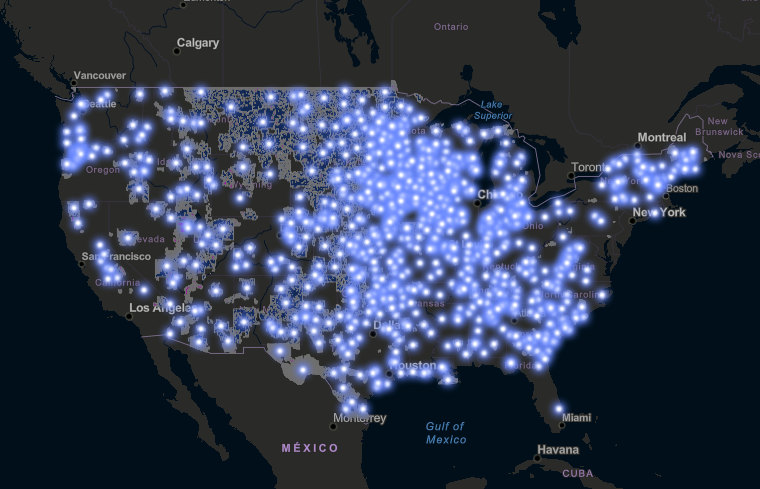
    Stepping back, NTCA has been no big fan of the National Broadband Map. It is riddled with errors that we’ve noted time and again. But at least at a macro level in terms of assessing who generally tends to serve where, it can certainly provide some value. And, boy, what a story it tells when it comes to who really serves most of rural America—and who really doesn’t.

    Let’s start at the 50,000-foot level—the continental United States. The National Broadband Map tells a story of two countries when it comes to nationwide cable broadband coverage. At first glance, it sort of reminds me of that old New Yorker magazine cover where everything more or less stops at the Hudson River and then you end up right in the Pacific Ocean. It’s not quite that bad, of course. If you happen to live in Dallas or Houston or Chicago, or other metropolitan areas like Santa Fe or Salt Lake City or Boise, or even a scattering of smaller cities and larger towns between the coasts, you might be lucky enough to have the choice of getting broadband from a cable company. But get outside of the more densely populated areas, and you’re largely out of luck.

    Now let’s flip over to where others offer fixed broadband across the continental United States through DSL/copper, fiber or licensed fixed wireless. Quite the difference. Now, not all of those spots are served by rural telcos—there are of course others, such as larger carriers and WISPs, who operate in some of those rural places. And again, the map isn’t always entirely accurate in showing each provider’s coverage.  But at a high level, as a matter of showing general trends, the coverage difference is striking. It shows you who really serves the rural areas and who likes to stick closely to the towns and cities.

    But maybe I’m missing something. Maybe if we get more granular, we’ll see a different result. Maybe we’ll be able to see that cable coverage really does leak out of the towns and cities and “into the countryside” once we zoom in on the National Broadband Map.

    Nope. That doesn’t change the picture much at all. If anything, it just highlights that cable broadband coverage tends to fall along the towns and cities that dot state and interstate highways in states like Nebraska or Virginia or Washington. Contrast that with the coverage by other fixed broadband providers using fiber, DSL, other copper or licensed wireless in Nebraska or Virginia or Washington. The point is that if you’re a rural resident and if you happen to live outside franchised limits, you’re likely getting your broadband from someone other than a cable company (assuming you can get broadband at all).

    To be clear once again, we at NTCA have lots of concerns regarding the accuracy of the National Broadband Map. It isn’t very reliable in telling who serves specific locations or small geographic areas (such as census blocks), and the use of uncertified self-reporting to establish speeds and actual coverage raises all sorts of questions. The map also doesn’t tell you if rates are reasonable for broadband, or if anyone actually offers reliable and affordable voice service (including access to 911) out there. Thus, the map certainly isn’t reliable enough to use as the presumptive decision-maker in important policy decisions. But the map can still be somewhat instructive in at least two respects: (1) highlighting the difference in even what different industry sectors self-report regarding their efforts to reach out into rural areas; and (2) highlighting that more remains to be done to make sure that every American can participate in a broadband-centric world.

    I’m not so naive to think that these debates will end or that efforts to undermine rural broadband investment programs will stop just because someone highlights that those fighting such essential programs have shown little interest in actually serving the most rural areas. These are complex issues, and the point-counterpoint debates will go on. But I would hope that those who make the decisions about the fate of these important programs will at least take stock of the fact that these programs are critical to serve areas where the opponents of such programs have often dared not to tread.

    Thanks for reading and for your continuing support of your association.

  • NTIA Report: U.S. Broadband Availability Nearly Ubiquitous

    According to a newly-released NTIA report, in 2012 98% of all Americans had access to basic broadband availability, defined as service of at least 3 Mbps downstream/768 kbps upstream.

    The NTIA report, entitled “U.S. Broadband Availability: June 2010-June 2012,” is the first in a series of Broadband Briefs that uses publicly available data collected by the Department of Commerce to examine broadband availability in greater detail.

    The report also finds that just over 93% of Americans have access to wireline broadband at advertised speeds of at least 3 Mbps/768 kbps, and nearly 93% have access to at least 6 Mbps. Ninety-one percent have access to 10 Mbps, and 78% to 25 Mbps.

    At 3 Mbps/768 kbps, 87% of the population has access to broadband via cable, 74% through DSL and 20% through fiber to the premises.

    Examining the urban/rural divide, the NTIA report finds that nearly 100% of urban residents have access to download speeds of at least 6 Mbps, compared to 82% of rural residents. Nearly 88% of urban residents can access broadband service of 25 Mbps, versus 41% of rural residents. (The NTIA report uses the Census Bureau’s definition of rural, i.e. areas not including any place with a population of 2,500 or more.)

    The report uses current data from the June 30, 2012 State Broadband Initiative dataset, which is the same data that populates the National Broadband Map, as well as historical data from June 2010 and June 2011.

  • Set-Top With Integrated Antenna Intended to End-Run Retrans Fees

    Move over, Aereo. Another media storm on the battles between video providers and broadcasters emerged last week when DirecTV’s chief financial officer mentioned that the satellite company was considering integrating an over-the-air antenna into its set-top boxes. This would allow consumers to seamlessly view locally broadcast signals along with other content provided through DirecTV. If this were done, it would permit DirecTV to avoid paying the massive retransmission consent fees that are increasingly problematic in the video services market.

    Years ago, DirecTV’s set-tops used a similar feature to make it easier for customers to view local over-the-air channels using DirecTV’s equipment. The integrated antenna was no longer needed after legislation allowed satellite providers to deliver local stations’ broadcasts to customers within the appropriate Designated Market Area (DMA). This law must be reauthorized periodically, leading many to wonder if DirecTV’s consideration of a return to integrated antennas is serious, or a ploy for leverage in its retransmission consent negotiations with broadcasters against the backdrop of Congress considering which, if any, video laws it might want to re-examine.

    Although its origins are in serving rural markets where over-the-air signals are difficult to receive, DirecTV has since expanded into many suburban areas. However, the transition to digital television that occurred in 2009 reduced the distances that many broadcast signals could effectively travel.

    For rural consumers located further from broadcast towers, an over-the-air antenna integrated into a set top box would be of little to no value, regardless of whether they receive video from a satellite or terrestrial provider. In addition, much network broadcast content is owned by the same few companies that own the most popular cable content, including sports programming, which is routinely tied together in “take it or leave it” packages. In short, the value of an integrated over-the-air antenna is at least questionable, especially for those serving the most rural areas.

    Yet even with these limitations, the return of integrated antennas into set-top boxes would result in some reduction in a video provider’s dependence on the costly retransmission consent regime for access to local content.  Given the indications that these costs will only continue to rise, providers’ search for alternatives will continue as well.