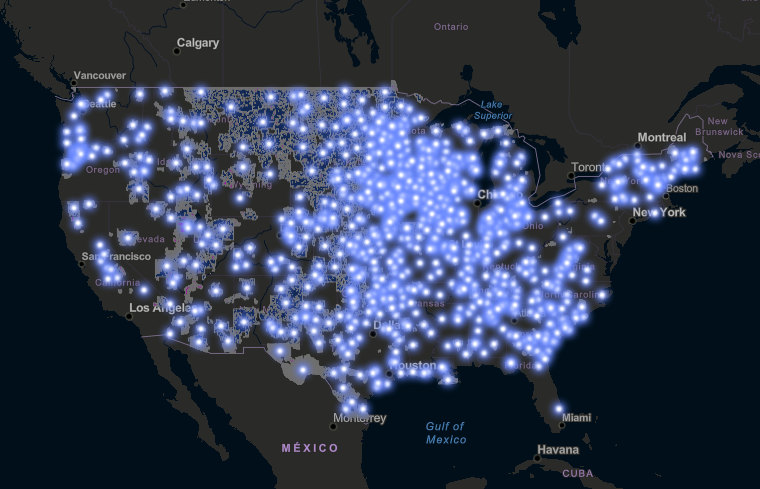
The LightSquared Week in Review

Early last week, LightSquared announced that it had signed its 39th wholesale agreement, welcoming Telcom Ventures to the 4G LTE service. Telcom Ventures operates two services, Assist Wireless and New-Talk. Both services carry the FCC certification of Eligible Telecommunications Carrier (ETC), which allows them to provide lifeline services to low-income subscribers.

LightSquared‘s plans are currently on hold, waiting for approval from the FCC before it can begin operations with its wholesale partners. Read more

Industry Event Focuses on Spectrum Shortage

A panel composed of government and industry representatives was in agreement today that access to spectrum is one of the most important policy and technical considerations for the evolution and growth of wireless broadband networks and devices. “The Wireless Home and Wireless Policy” event featured a keynote presentation by Rick Kaplan, FCC Wireless Telecommunications Bureau Chief, and a panel discussion.

Sponsored by Broadband Breakfast — a Washington-DC based news organization — the panel also consisted of the FCC’s Rick Kaplan; Fred B. Campbell, Jr., President and CEO, Wireless Communications Association International (WCAI); Walter B. McCormick, Jr., President and CEO, USTelecom; Grant Seiffert, President, Telecommunications Industry Association (TIA); Gary Shapiro, President and CEO, Consumer Electronics Association (CEA); and moderator Drew Clark, Chairman and Publisher, BroadbandBreakfast.com. Read more

Sen. Grassley Continues, LightSquared and Others on Hold

Sen. Charles Grassley (R-Iowa), has requested information from GPS companies in regard to communications between the investment group (Harbinger Capital Partners), the FCC and the White House prior to the granting of an ancillary terrestrial waiver to LightSquared. Sen. Grassely has given the GPS group, which includes Garmin and John Deere, a deadline of January 25. He has requested the same info from the FCC and Harbinger Capital Partners. Read more

Spectrum for Medical Micropower Networks

The Federal Communications Commission has adopted a report and order allocating 24 Mhz of spectrum in the 413-457 Mhz spectrum band. Operating on a “secondary basis,” this allocation will provide medical micro-power networks enabling new implanted medical devices which are intended to assist in the restoration of sensation, mobility and function to paralyzed limbs and organs.

The order includes service and technical rules, including provisions that require the use of one of four frequencies and the capability of monitoring and shifting frequencies as those in use become occupied. The report and order is the result of a 2007 petition by the Alfred Mann Foundation. The foundation has shown through performance testing that the devices can be used without causing interference to co-channel operations.

FCC Chairman Julius Genachowski noted at the commission’s November 30 open meeting that “It’s already helped people who previously had no hope of recovering movement or motion in their limbs.”

EATEL is the First ILEC to Partner with LightSquared

LightSquared announced this morning that it has entered into a wholesale agreement today with rural ILEC and NTCA member EATEL. The agreement will allow EATEL to provide its customers with access to LightSquared’s proposed wholesale, nationwide LTE network integrated with satellite coverage.

EATEL, founded in 1935, is the incumbent local phone carrier in the Ascension and Livingston Parishes of Louisiana. Based in Gonzales, La., the telco provides high-speed Internet, phone and television service over a fiber-to-the-home (FTTH) network.

“LightSquared’s network not only allows EATEL to offer our existing customers wireless broadband services, it also gives us a critical competitive advantage as we expand our services into new markets,” said John D. Scanlan, EATEL president. Arthur “Smokey” Scanlan, EATEL’s chief executive officer, added that “LightSquared’s unique ability to offer both broadband and satellite connectivity over the same device will be a breakthrough product for our customers.”

With this agreement, EATEL becomes the first ILEC to sign on to LightSquared’s network.LightSquared continues to face major regulatory and technical hurdles which must be resolved before it can offer service, chief among them concerns about potential interference between its proposed network and GPS devices. LightSquared remains engaged with the NTIA, members of the military and the GPS community in testing its network and devices.  Read more

TV Channel 51 Frozen

Following petitions by the Rural Cellular Association and CTIA-The Wireless Association, the FCC ordered a freeze on broadcast applications for licenses on channel 51. The associations assert that TV signals originating at channel 51 cause interference in adjacent wireless transmissions. Channel 51 is adjacent to the A-block of wireless licenses that operate using spectrum between 698 Mhz – 704 Mhz, and 728 Mhz – 734MHz.

Stations licensed to channel 51 operate at the “top end” of the allocated broadcast spectrum. (Prior to the digital transition in 2009, the channel range had extended further, to channel 69.) In freezing both new and pending applications, the FCC also opens a 60-day window for low-power applicants for channel 51 assignment to amend their application to a different channel.

Stations currently operating either full-power or low-power at channel 51 may apply for waivers to make modifications to their broadcasts.

Despite Industry and Congressional Obstacles, LightSquared Moves Forward

There are several new elements to the continuing pre-launch LightSquared story.

First off, LightSquared filed its formal report on GPS interference at the FCC on June 30. The report indicates that LightSquared will proceed with its network build out via a “plan B.” As we reported a few weeks ago, the new plan requires using spectrum lower in the band, further away from GPS frequencies, and operating at 50% power. In addition, LightSquared is requesting that filters become a requirement for manufacturers of certain GPS equipment.

In a public statement LightSquared said, “The FCC does not face a stark choice between reliable GPS service and a new competitor in the broadband market. In fact, the testing results released today show LightSquared’s proposed solution resolves interference for approximately 99.5% of all commercial GPS devices, including 100%of the 300 million GPS enabled cell phones.”

Second, an FCC working group has also completed testing of LightSquared’s proposed plan for a nationwide 4G LTE network and in the summary noted that, “The LightSquared Terrestrial Broadband Service Will Cause Harmful Interference to Nearly All GPS Receivers and GPS‐Dependent Applications.”

It’s important to note that the working group’s conclusion was derived by testing LightSquared’s initial spectrum utilization plan and not its latest plan B deployment plan.  Read more

« Previous PageNext Page »