Verizon Estimates 50% of Their Wireless Traffic is Video

Speaking at the National Associations of Broadcasters convention in Las Vegas, Verizon Communications CEO Lowell McAdam estimated that half of the data carried on Verizon’s wireless network is video, and that he expects the total to reach 75% by 2017.

McAdam credited Verizon’s investment in its LTE network as the key factor enabling such large scale video delivery.  “With 3G you have video clips but there is buffering,” he told the audience.  “With 4G you can stream video.” Read more

Screen Time: Nielsen Data Reveals Changing Habits

Viewing habits are changing. If an older generation ever wondered what would entice children away from TV, future marketers might wonder what they might do to drive people toward TV – or at least “TV” as we know it.

Nielsen data released last week reveals that five-million households have replaced TVs with tablets, computers and other devices. This represents a two-million household increase since 2007, but yet accounts for only about 5% of all uses.

Notably, however, the data does not account for households where traditional TV viewing occurs, but has taken a back seat to Internet-enabled devices. So, among that 95% there may be many whose primary video usage occurs on a tablet, with TV used less frequently. Read more

Google Fiber: 100 Miles and Counting in Kansas City

The New Edge has been closely following the developments of Google’s experimental 1 Gbps fiber network the company is deploying in Kansas City, Kan., and Kansas City, Mo.

In early February, Google announced that it was finally ready to start stringing fiber on utility poles throughout the city, having resolved any outstanding issues with the local utility company. This week, Google issued an update on its construction progress, announcing that its crews have already hung more than 100 miles of fiber.

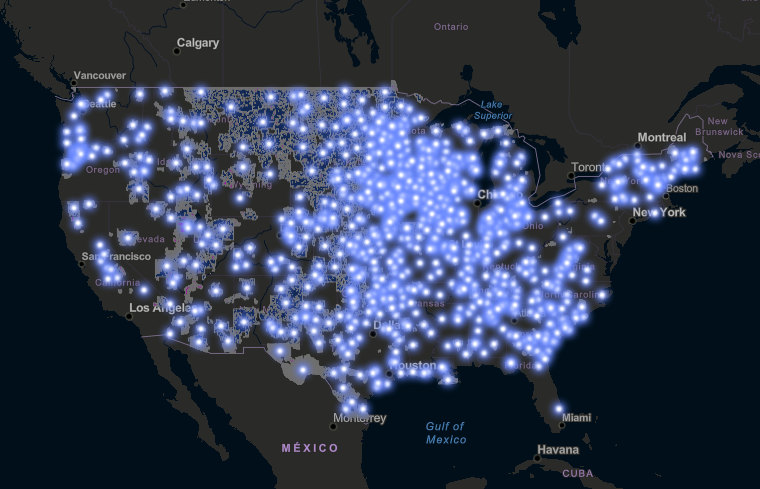
John Toccalino, a manager for Google’s Kansas City fiber project, provided this basic diagram (view the image after the jump) showing the network architecture. Google is building several equipment aggregation centers — or “Google Fiber Huts” – from which the fiber cables will travel along utility poles into neighborhoods and homes. Google also is installing some fiber underground. Read more

Google Petitions for Antenna Farm

Google Fiber has petitioned the FCC to begin construction on a satellite antenna farm. Google Fiber, a subsidiary of Google, is requesting permission to place the antennas near its Council Bluffs, Iowa, data center.

Google intends to receive broadcast and other television network signals at the Iowa location, possibly to bundle them in with its high-speed fiber service.

Google announced earlier in February that it was making final preparations to begin laying in fiber from Kansas to the Missouri line. Google indicated late last year that it was contemplating adding video services to its Kansas to Missouri fiber optic service. Last Friday, Google reportedly filed franchise applications for cable distribution service in Kansas City, Kansas, and Kansas City, Missouri.

The plans for the satellite antenna farm call for 4.5 meter antennas to receive analog and digital audio signals, data transmissions and video signals. Google notes that it will receive both domestic and international satellite feeds.

Blockbuster To Offer Subscription Streaming

Though Blockbuster currently provides an “on-demand” streaming service, Dish Network confirmed on Tuesday that Blockbuster would begin providing a subscription streaming service. This will place it squarely in competition with Netflix.

Dish Network purchased the video rental company in April for $320 million. Blockbuster is equipped with a huge film library and a 28-day advantage over Netflix and Redbox for some new-release titles. Though no timeline was given, it is believed that the new streaming service will begin fairly soon.

Read more

Apple Considers Hulu

Although the company declined to publicly comment, Apple is said to be in discussions concerning a possible bid for online video site Hulu. Last week, the owners of Hulu — Walt Disney Co., News Corp., Comcast and NBC Universal — confirmed that the ownership of Hulu was definitely in play.

A possible Hulu acquisition would provide Apple with a new subscription service featuring more video. Currently Apple provides video for it’s popular iTunes customers on an on-demand rental basis rather than a subscription.  Comcast, Disney and News Corp. have built a program rights extension of five years into the sale, creating a strong potential alternative to Netflix.

Estimates are that Hulu will command more than $2 billion.

For more, see this Bloomberg News article.

Tennessee Law Makes it Illegal to Share Your Streaming Media Account

Last week Tennessee became the first state to make it illegal to share the user name and password of any streaming media account. The bill, signed into law June 1 by state Governor Bill Haslam, makes it a crime for anyone other than account holders to access services such as Netflix, Hulu Plus, Amazon Instant Video or Rhapsody. The law also provides service providers with legal recourse against the violators.

Streaming media — and Internet video in particular — is gaining in popularity and overall share of Internet traffic. Consumers increasingly want to store their digital content in the cloud and access it from any device. Apple, Amazon and Google have each announced plans to launch cloud music services.

The recording industry championed this bill in an attempt to account for losses through illegal file sharing. Tennessee’s capital is home to many of the major record labels, including Sony Music Entertainment, BMI, Warner Music Group and EMI. This state law is clearly an attempt to catch up with technology and, IMHO, stop the train after it has already left the station.

However, the bill overlooks one very important point; most application providers already protect their content through their official terms and conditions.

Read more

Next Page »