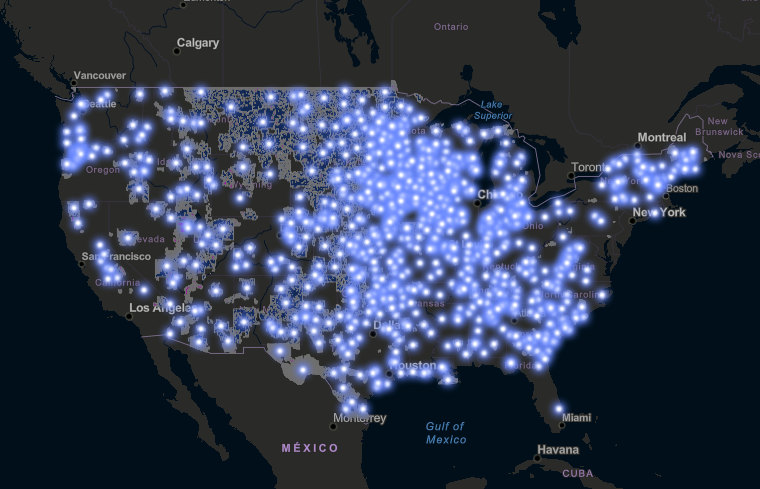
ALA Finds Broadband Stimulus Benefits Libraries

A recently released study conducted by the American Library Association (ALA) found that more than 20 percent of the nation’s libraries have benefited from broadband stimulus programs.  The Broadband Technology Opportunity Program (“BTOP”) arose out of the American Recovery and Reinvestment Act of 2009 (also know as the Stimulus Act).

The BTOP grants referenced in the study fell into three categories: the Public Computer Center Grants, the Sustainable Broadband Adoption Program, and the Comprehensive Community Infrastructure Program.  The majority came in the first category. Read more

The Hierarchy of Nerds: Blending Star Wars and Psychology

Screen-shot-2012-05-14-at-10.28.00-AM This might be one of the few D.C. trade association blogs that could open with a re-posting of a thesis  that Chewbacca was actually a highly-placed spy, and Han Solo was simply an unwitting cover for the hairy agent.  A friend of mine forwarded the post to me last year in an email saying, “My mind is officially blown. Destroyed. I can’t look at Star Wars the same way again.” If you’re a Star Wars fan, then the original post is worth a read. If you’re not, then I’ll skip to the point and propose that there are instances in which a novel approach to a common problem can open new and innovative perspectives.

kiwi_orange_socks-1961268

Illustration courtesy kiwi_orange_socks

About a month ago, Ben Thompson on stratechery.com proposed that Abraham Maslow’s “Hierarchy of Needs” can be translated to define the mobile wireless market, with specific application (no pun intended) to the iPhone. OK. That’s a mouthful, and I’ll be honest – until I saw the post, I had no idea who Maslow or what the Hierarchy of Needs were; as Clint Eastwood admitted to Rene Russo in In the Line of Fire, “I had to look it up.” But, here it is in a nutshell: Maslow, an American psychologist, proposed that basic human needs must be met before more intricate goals such as morality, problem solving and creativity can be mastered. The theory is often presented in pyramid form, with physiological needs such as breathing, eating and sleeping occupying the base layer while employment, friendship, self-esteem and confidence take roost at upper levels. Stated simply (and perhaps robbing Maslow’s observations of their elegance), property doesn’t matter if you’re not eating. Or, as Thompson notes, “until lower order needs are met, we don’t really pay attention to or pursue higher order needs.” Read more

Rising Programming Costs Hit Smaller Providers Harder; More Flexibility Needed

A new report from market research firm Moody’s Investors Services confirms that smaller video providers are harder hit by rising programming costs than their larger counterparts. Of course, this comes as no surprise to rural multichannel video programming distributors (MVPDs). The report also does not exactly go out on a limb when it predicts that the gap between what small and large MVPDs pay for content will probably continue to increase in the coming years. Smaller companies’ relative lack of bargaining power leads to steeper cost increases, according to Moody’s. In contrast, companies like Comcast, with 22 million subscribers, and Time Warner Cable, with about 12 million, can leverage their scale to contain their content costs to less damaging levels (in addition to, in some cases, leveraging their ownership of sizeable parts of the content in question).

Moody’s does not expect major changes in the structure of programming contracts in the foreseeable future. Therefore, retransmission costs will continue to grow, and become a greater percentage of an MVPD’s (and thus consumers’) overall costs. As media consolidation continues, the bargaining disadvantage of smaller providers will only get worse, according to Moody’s. This, in turn, could lead to more consolidation among smaller MVPDs. Read more

Microsoft Unveils Skype for Outlook.com

Last week, Microsoft introduced a preview edition of Skype for Outlook.com in the UK. The product is scheduled to be rolled out in the United States and Germany in the coming weeks.

The new product will feature the ability to engage in video and audio calling powered by Skype embedded in every Outlook.com (a free email service) inbox. Once set up, a user reading an email on Outlook.com can simply move their cursor over the picture of the person who sent an email, or of anyone in their contacts, and initiate a Skype call or chat session. Once a user’s Skype and Microsoft accounts are merged, their Skype contacts will merge into Outlook.com. Set-up requires the download of a plug-in for users’ Internet browser, although only the most recent versions of Internet Explorer, Chrome and Firefox are supported. Details on additional browser support are forthcoming.

When Microsoft purchased Skype in 2011, critics questioned how the two companies with such different services could merge their products in a way that made sense to consumers. Two years later, Skype for Outlook.com represents the first major step towards integrating the two services.

Microsoft recently launched a new version of Outlook.com, and claims it has not only been a wild success (with 60 million users), but that it is attracting numerous Gmail users. The new Outlook.com replaced Hotmail, which had for several years been badly languishing behind Gmail. Bing has been slowly increasing its market share, and the success of Outlook.com may have given Microsoft some momentum. The launch of Skype for Outlook.com may continue that momentum and enable Microsoft to push back on Google’s market share.

CenturyLink to Conduct 1 Gbps Test Project in Omaha

CenturyLink will offer 1 GB broadband service to 48,000 homes in Omaha, Neb., beginning May 6The company’s goal is to have all targeted customers connected by early October.

Residential customers who are part of the program will be charged $79.95 monthly for the 1 GB service when bundled with other CenturyLink offerings. The stand-alone price will be $149.95 per month.

“CenturyLink is pleased to offer its Omaha customers ultra-fast broadband speeds up to 1 GB to help keep pace with growing broadband demands,” said CenturyLink COO Karen Puckett.  “This demonstrates our commitment to deliver communications solutions that provide our customers with the technology they need to enhance their quality of life, now and into the future.”

It is unclear whether CenturyLink’s 1 GB service will be subject to a usage cap.  Currently, CenturyLink caps 1.5 Mbps service plans at 150 GB, and caps any faster service at 300 GB.  The company also reserves the right to remove what they consider to be excessive users from their network.

According to a company release, CenturyLink “will evaluate its Omaha 1 GB offer before determining further deployment of this advanced technology, considering such factors as positive community support, competitive parity in the marketplace and the ability to earn a reasonable return on its investment.”

Baseball, Washington Style

Policy Perspectives

April 2013 158

In Washington, even the baseball games feature a Presidential race.

There is probably little doubt that the phrase “buzz kill” was invented to describe Washington, D.C. At a Nationals game last week, the ceremonial first pitch was tossed by…the acting administrator of the EPA. To be fair, it was Earth Day, and I do not intend any personal or professional affront to the acting administrator. But, only in Washington would bureaucracy be confused with celebrity.

I experienced another brush with the concept of substitution last week, also at Nationals Park. I took my family to the Nationals-Reds game, mostly because my former “hometown” Reds were in town. But, my enthusiasm for the Reds had dipped during a period of soulless management that coincided with the 1994/1995 strike, and the rebirth of baseball in D.C. over the past several years (and also energized by the Nats’ stunning regular season and wrenching post-season last year) made me somewhat ambivalent as I entered the first base gate. To the accurate meaning of the word, I had strong feelings in both directions: the white “C” on the Reds caps still affects me, yet on daily basis I still check for the Nationals scores first. An economist might ask whether (for me, at least) the Reds and Nats are effective substitutes. Read more

IP Possibilities Conference Highlights the Benefits of Becoming a Smart Rural Community

photo1

Nearly 500 attendees gathered in Minneapolis, Minn., for the IP Possibilities Conference & Expo.

The 2013 IP Possibilities Conference & Expo took place April 16-18 in Minneapolis, Minnesota

The Smart Rural Community was a key theme of the event, with speakers discussing what defines a smart rural community, and how rural broadband providers can participate in the program. A late spring snowfall could not deter nearly 500 attendees and more than 50 exhibitors from examining the latest technologies and strategies carriers are using as consumers and the industry transition to an all-IP environment.

Steve Gleave, vice president, marketing, MetaSwitch, provided the lead keynote. Gleave highlighted powerful and specific opportunities for network owners, discussing high-end next- level services. Gleave noted that customers are using carriers’ broadband networks to utilize many applications and services, so it only makes sense for carriers, who already have relationships with these customers, to offer these services themselves. Gleave also discussed the software defined telco of the future and challenged the audience to prepare for this eventuality. Read more

« Previous PageNext Page »