

Sometimes in the advocacy arena, it’s important to find a different way and new voices to share the same story. That is why I always look forward to the NTCA Women in Telecom Fly-In every year.
For the past several years, we have asked our women leaders to come to Washington, D.C., for a special day of meeting with key female policymakers from Congress, the FCC, the U.S. Department of Agriculture (USDA) and other related agencies to share the opportunities they are seeing in their communities to serve their consumers and ways they are working to deploy and sustain broadband built to last.
It has also been a wonderful way to share the diversity that we are seeing in the rural broadband labor market – women not only leading companies but also creating pathways for success in the technical, engineering and financial roles of the industry. I welcome that more companies are giving women on their teams the opportunity to participate.
This year, our adventure started off with a lovely breakfast hosted by our friends at Womble Bond Dickinson, where we had a chance to catch up with one another and share updates on NTCA’s Women in Telecom (WIT) program, which has been very busy this year with mentorship programs, book clubs and industry training. We were also joined by Aylene Mafnas, deputy assistant administrator within the Rural Utilities Service, who shared updates on some terrific streamlining measures that are being put in place to help ease the agency’s loan and grant process. She also shared some entertaining stories about her times climbing poles while starting her career as a telecom engineer in Guam.
We then made our way over to the FCC. Due to visiting restrictions during the pandemic, this was the first time many of our attendees had visited the commission in its new location. We had the privilege of meeting with newly minted FCC Commissioner Olivia Trusty, who gave her first official speech to our attendees before joining in a robust round of questioning from the group. Everything from mapping challenges to national security to the Universal Service Fund (USF) was on the table. Having known Olivia for many years, it was really a treat seeing her in this role and the grace and wisdom she will bring to it.

Next, we divided into small groups to grab a bite to eat before heading over to the Capitol Visitor Center, which is a great place to visit, even if you aren’t having congressional meetings. The Capitol building and visitor center have two statues representing famous “alumni” from each state, and it is always a mini-history lesson to itself. (Yes, the blasting air conditioning was also a relief on a day where the real-feel temperature hit well into the triple digits!)
While there, Sen. Shelley Moore Capito (R- W.Va.) joined us to share her thoughts on the Broadband Equity, Access, and Deployment (BEAD) Program and the next steps with the USF working group. As a long-time supporter of initiatives to build networks into rural communities, she always finds time in her busy schedule for our WIT folks. I’m especially grateful for her ability to draw her own parallels between her efforts to elevate young women in West Virginia and speakers from the STEM field, showing others that “if you see it, you can be it.”

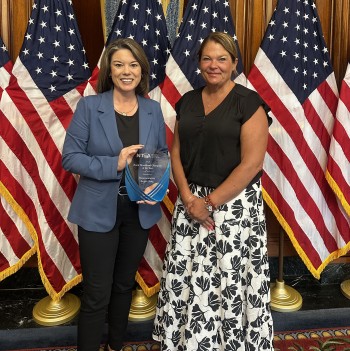
Next, while I admit I was limping and seeking shade at every turn, we walked to meet with two impactful women in the rural broadband space – Sen. Amy Klobuchar (D-Minn.) and Sen Deb Fischer (R-Neb.). Both of these leaders are members of the U.S. Senate Committee on Commerce, Science, and Transportation, and both are key players in helping shape the future of universal service.
While the meetings were separate, the themes were the same, and both Senate leaders shared their passion for ensuring that those Americans awaiting connectivity be connected sooner rather than later. They also acknowledged the critical role that the USF plays in ensuring that these networks are not only built, but that they are sustained and upgraded. While the politics in Washington can be really loud, making it easy to lose sight of the important things that can be accomplished, getting the same priority list from both sides of the political aisle always gives me faith that good policy will trump all in the end.
I’m not sure how many of our attendees actually made it over to the Congressional Women’s Softball Game later that day at Audi Field, because I for one needed to take my shoes off. But the day was a success, and I am always grateful for the women leaders in our industry adding their unique and impactful voice to the policy discussions.