

The Intrepid Travelers struck again, this time to get a taste of the Muslim world without literally traveling entirely across the world. Destination? Morocco.
Morocco is one of the world's most unique destinations. Despite having shores close to Spain, the country is located in Africa, and its population is primarily from the Middle East, with heavy French, Berber, and Spanish influences. The areas of greatest population are located in the north, where much of the coast hugs either the Atlantic Ocean or the Mediterranean Sea. The southern part of the country is covered by the legendary Sahara Desert, while the Atlas Mountains cut the country in half running west to east. When combined, you literally experience numerous ecosystems over just a few days of travel.
We ended up completing over 1,000 miles of travel, so while we missed the southern coast and the north to Tangier, I think we got a good taste of what Morocco has to offer. And speaking of taste, Moroccan food is amazing and fresh, and there’s always plenty of couscous to go around!
We were initially intrigued by the country because of a direct flight to Casablanca from Dulles Airport in Washington, D.C., on Air Maroc. However, it turned out to be too good to be true, as the airline clearly gets to decide when they really want to fly (or not). Despite having a schedule with departures four days a week, Air Maroc chose to cancel “our day” about a month before travel. It was nerve-racking and particularly annoying, but we were able to find a flight through Paris. Thankfully, in the midst of the cancellation, my body clock was so off as a result of the NTCA Fall Conference occurring on the West Coast that I was up at 4 a.m. the day our flight was canceled, so I was able to find a suitable alternative before my first breakfast of the day! Still, I did learn an important lesson about national airlines owned by a country and subject to their own whims.
Casablanca itself evokes the classic Humphrey Bogart and Ingrid Bergman movie. The French Legion has long been replaced since Morocco gained its independence in the mid-1950s, but you can still certainly feel the vibes—particularly if your travel folks set you up at Rick’s Café for dinner, complete with a piano player. Given our later-than-planned arrival, we did a speed tour of Casablanca and made a point of hitting the King Hassan II Mosque with its 690-foot minaret (mosque tower). It’s the tallest in the world, and frankly, the entire area was pretty spectacular. Over 100,000 Muslims can worship in the space and plaza at one time.
After that, it was on to Rabat, the capital city. Pulling into Rabat is a bit like driving into the flat version of Greece’s Santorini—all white and immaculate. The government buildings are sprinkled between royal palaces, of which there are apparently more than 20 owned by the current rulers—none of whom seem to be in residence at any one of them. And no, none of these palaces are open for touring. Sadness.
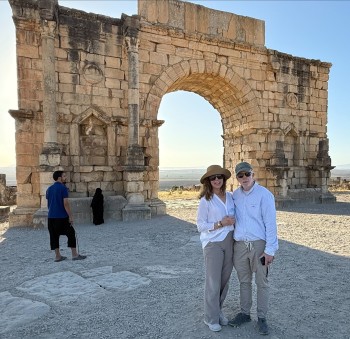
The monarchy is a big deal in Rabat, and it traces through generations with spectacular wealth. The funniest part of our tour through Rabat came when we stopped at McDonald’s because we were running late to make our way to some old Roman ruins. How’s that for an authentic dining experience? (Although Moroccans love their feral cats, so you’d never see an American McDonald’s with so many feral cats being fed French fries!) We made up for the lunch with more than enough tagine and couscous over the rest of the journey, but it was a fun way to compare Happy Meal menus!
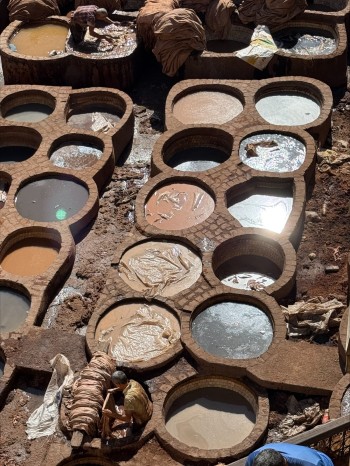
Fes was next on the agenda, and it was here where you really stepped back into the Middle Ages. We stayed right outside the gates of the world's largest and oldest living medieval medina (or imperial city). You can spend days wandering through the maze of 9,000 narrow lanes, alleys, and souks that form the core of the old city. The sounds, the smells, and the hub of activity in what is literally the world's largest market were worth the full day of wandering, and I am certain Don and I walked about eight miles for various stops of traditional Moroccan salads, dates with almonds, colorful carpet shopping, and an amazing tour of the tannery in the middle of the market.
Guess what type of animal skin is the best for leather production? I thought cow, but it turns out I was seriously wrong. Camel skin actually wins on all accounts. It’s soft, light, and supple. Although we’re unlikely to find a lot of camel leather products in the United States, it was interesting nonetheless—particularly as we watched what might be the hardest job in the world, where barefoot workers tromped in vats of something likely toxic to soften and color the hides. It’s something to remember when you’re having a tough day; someone always has a tougher job.
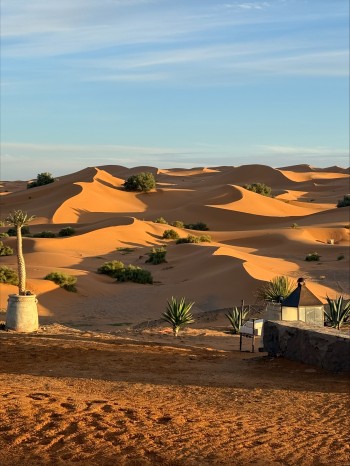
We then made the long but interesting journey from Fes through the mid-Atlas Mountains to the Sahara Desert portion of Morocco. While it’s evident that there continue to be political questions and conflicts regarding just how much of the Western Sahara falls under Moroccan rule—thanks to ongoing tensions with neighboring Algeria—you truly enter a new world when you drive out of the mountains and start to see hills of sand that seem to change color with the light of day. The roads become less paved, the shops become less focused on tourist traffic, and wild camel herds appear on the horizon, clearly paying no attention to international boundaries!
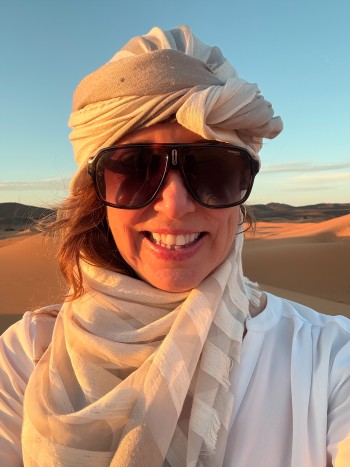
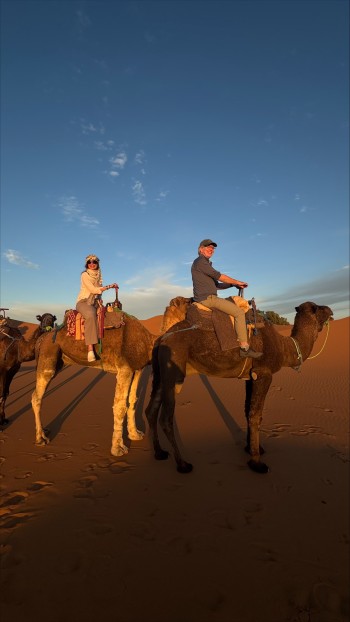
A highlight of this portion of our adventure was the opportunity to spend the night in the desert under a tent while taking a camel trek before sunset. I had been gearing up for this part of the trip the entire journey, and it certainly did not disappoint. After ensuring that we were appropriately attired (complete with a headscarf to block the blowing sand), we tromped over sand dunes to meet our camels (or technically dromedaries, which are Arabian camels with one hump). I’d heard about camels biting, so I was a tad concerned about the riderless camel tied tightly behind mine, which continued to bray most of the trip. By the end, I found camels to be somewhat endearing, with a renewed appreciation for just how tall these creatures are.
Did you know you board them while they are seated (which they are trained to do, not unlike dogs), and you hang on tightly as they unfold their legs in two separate jerking motions to rise to their feet? And did I mention hanging on for dear life while a Bedouin guide takes you over the dunes with hopes that he’ll understand “help” if and when I were to fall off? The journey wasn’t terribly far, and upon reaching our destination, we dismounted to begin our own climb to the top of a dune for the sunset. We then tumbled down the dunes again to ride the camels back to camp. Even after a relatively short time on the back of the camel, as I tried to imagine what it must have been like to cross the entire Sahara, my thighs were already screaming from just the short jaunt. More power to those early travelers.
While we were far from established towns, I remained impressed by the access to power in our small camp, thanks to solar technology. Talk about tapping your assets when you have over 320 days of sunshine a year. And, as is always at the top of my inquiring mind, I was focused on how connectivity could exist in these rural portions of foreign lands, where the poverty level is far below much of what we can ever imagine in the United States. But still, there we were in the middle of a desert that stretches across thousands of miles and numerous countries, and we were connected.
The country of Morocco's current king has made a significant focus on infrastructure, and the government has specifically prioritized modernizing its telecommunications sector to improve digital inclusion and support economic development. Its “Digital 2030” strategy aims to connect 5.6 million households with fiber and improve internet access in 1,800 rural areas. All the providers are burying infrastructure to increase capacity and reliability, and they have created some joint ventures to really amp up fiber deployment—particularly through the creation of what they’re calling FiberCo, which has a goal of expanding fiber optic networks to three million connections within five years.
Like in most places around the world without community-based providers, rural areas in Morocco lag behind. But this joint venture is meant to specifically address the urban-rural divide and ensure it does so in a future-forward way with fiber. Kudos to this African country for making wise investment choices. There is often speculation that all of Africa must resort to satellite service as the last-resort option, but that’s not so.
Learning more about this country's priorities makes my heart ache just a little bit more when it comes to how the Broadband Equity, Access, and Deployment (BEAD) program is turning out for rural America. We truly had a once-in-a-generation opportunity to make the right investment, and I am personally so disappointed to see more of a priority on turning back funding, not providing matching fund waivers, extensive “pencil sharpening” that is a denigration of the initial technology planned, and now placing conditions on the role the Universal Service Fund can play in ensuring that services brought to the hardest-to-serve parts of our country can be sustained. All missed opportunities.
We ended our journey in Marrakech for the last few days, where the mosques were plentiful, the culture amazing, and the marketplace bustling. I am delighted that we took the time to make the drive hitting various parts of the country. Not unlike when I was a child and we would make our annual family vacation treks to the Badlands in South Dakota, the Rocky Mountains in Colorado, or Mammoth Cave in Kentucky, I picked up the most information about the journey and the people from looking out the window as we traveled, ate at local diners, and spent time embedding in the culture. This stop was a bit more exotic, and it’s got me feeling that maybe I should be a goat shepherd in my post-NTCA life!
Our trip was a celebration of our 40th wedding anniversary. It was also a great way for me to continue to feed my curiosity about how countries around the world view and prioritize their connectivity access for all their citizens—and how that connectivity continues to improve lives as well as the local economy.