

What a year it’s been. As I reflect on 2025, what stands out most is not just the volume of activity, but the intensity of purpose with which our members and our team have worked to keep rural America connected, resilient and heard.
From Washington, D.C., to the heart of your communities, NTCA’s mission — to be a trusted national resource, empowering rural broadband providers to deliver reliable, high-quality service and drive community growth — has been at the forefront of every conversation and every fight we’ve taken on together.
One of the defining stories of the year was our work to defend and then push for reforms of the Universal Service Fund (USF). We’ve long held that universal service is the North Star for NTCA and rural broadband — not just getting networks built but keeping them strong and affordable for the long term — and that conviction took real shape this year.

After years of uncertainty surrounding the survival of the USF’s contribution mechanism, the U.S. Supreme Court affirmed its constitutionality in late June, providing much-needed clarity and allowing us to shift back to a critical and more focused debate over the future of universal service funding mechanisms. It was a tremendous victory for rural communities and the consumers, health care facilities, schools and libraries that rely on services supported by the USF. But we didn’t just celebrate that win, we got right back to work to refocus on critical reform efforts because even with the overhang of the judicial threats largely removed, what universal service will look like in the future and what resources will be available to support that mission are very much still hanging in the balance – in short, we are not out of the woods and we have lots of work still to do together.
Along these lines, NTCA submitted detailed recommendations to the bipartisan Congressional USF Working Group earlier this fall on how to modernize the fund so it works better for rural consumers and the networks serving them. We’ve called for more equitable contributions, smarter targeting of support and stronger coordination with broader federal broadband programs. And at a time when Washington, D.C., is more gridlocked than ever, it is critical that we keep our foot on the gas.
We’ve also stayed engaged on the Broadband Equity, Access, and Deployment (BEAD) program, making sure states implement this historic federal investment with both the letter and spirit of the law in mind. We urged states to use their authority wisely to fund networks that deliver real long-term value for rural communities rather than short-term fixes that won’t stand the test of time. We continue to push for transparency and real accountability now in what BEAD will deliver for the American consumers it serves and the American taxpayers who paid for it. And at every turn, we have advocated for grant programs like BEAD and future USF support to complement each other.
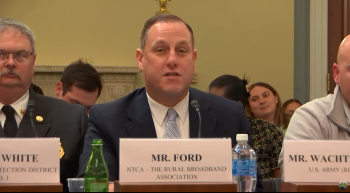
Staying on the policy front, we’ve seen some broadband mapping improvements in both the data and how the data is being used to make decisions. Although we’re a long way from perfection, the association has advocated for both better mapping and better use of maps, and this work will continue to be front and center for us in the new year. We are also following many of the deregulatory steps we’re seeing in Washington, from more common-sense broadband labeling to copper retirement provisions. It’s important that we keep this momentum going in 2026, as we continue to work toward smarter deregulation while promoting regulatory certainty. I was glad that our own Brian Ford and Leif Oveson had opportunities to present our perspective on much-needed permitting reform before Congress and the U.S. Department of Agriculture, as well.

Throughout the year, members of NTCA and staff from our Government Affairs and Legal & Industry teams have brought these themes directly to policymakers. And twice this year, hundreds of you came to Washington for our Legislative and Policy Conference and Telecom Executive Policy Summit to tell your stories and advocate for universal service, rural infrastructure funding and sustainable broadband policies. Thank you for these efforts. This is a very different Washington, D.C., than we have experienced before, and your visits make all the difference. I wish I could tell you things will slow down, but I would not bet on it!

As you know, it’s not all heavy policy work. Our Smart Rural Community program continues to inspire and educate our members and others to share their stories of local impact through connectivity. This year, the SRC program grew to include nearly 300 providers, and it was a true honor to present eight SRC Showcase Awards recognizing some of our most innovative members at Fall Conference. CyberShare: The Small Broadband Provider ISAC also saw impressive momentum, with participation expanding to nearly 150 member companies and more than 360 individual users. The NTCA Rural Broadband PAC had its most successful fundraising year ever, strengthening our ability to advance meaningful legislation on behalf of rural communities. And it was an outstanding year for the Foundation for Rural Service, which awarded scholarships to 50 high school students and community grants to 31 organizations doing important work across our members’ service areas.
All this work is made possible by you, our members, and your continued feedback on ways the association can be even more effective. I would be remiss not to note that the NTCA Board of Directors continues to lead our efforts with a steady hand, advancing our Strategic Plan and ensuring NTCA continues to be an industry leader through the transparent and inclusive process now underway to select the next CEO prior to my retirement from NTCA in March. As I mentioned at Fall Conference, this is not goodbye yet. I’ll continue to lead in my current role and ensure a smooth transition for the association’s next leader. In the meantime, rest assured that the Board and senior management team — comprising strategic leaders with decades of experience serving NTCA members — is strong and well prepared to support this transition.
Looking ahead, we know there is much more to do, from meaningful USF reform to responsible BEAD deployment, from improving broadband maps to advocating for sensible regulatory frameworks that favor future-proof networks. But as I close the book in 2025, I can’t help but think about the people I’ve met, the stories I’ve heard, the bonds we’ve built and the progress we’ve made together.
I hope the holiday season is treating you well. Whether we’re connecting around the AI Summit in January, RTIME in February or at any point along the way, your NTCA team looks forward to continuing to work alongside you in 2026.